
__ Feldklasse in carrots and onions
Significant cost savings: weeding in double and triple rows is possible.
Carrots, parsnips and onions are often grown in double or triple rows with a row spacing of about 7 cm (3 in).
Thanks to their rotary design, the Rukaby and Pacorel can be used to weed in these narrow row spacings (from 5 cm / 2 in). This greatly reduces the need for manual weeding. With a row spacing of 7 cm (3 in), the saving is between 30 and 40%.
Unchopped area of a Feldklasse weeder: 4 cm +4cm = 8 cm
Unchopped area of a conventional weeder that works only outside of the double row: 8 cm + 3 cm= 11 cm
The difference is 27% more area worked. As weeds that have been treated with the rotating tools are removed more reliably, the savings are even higher. The savings are therefore between 30 and 40%.
Advantages of the rotation principle
Unlike goosefoot shares, rotary shares push the soil backwards. This makes weeding possible in narrow rows. They also allow gentle weeding, even among young carrots.
Another advantage is that no soil is thrown from the ridge. This maintains its volume.
Clevere Werkzeuge
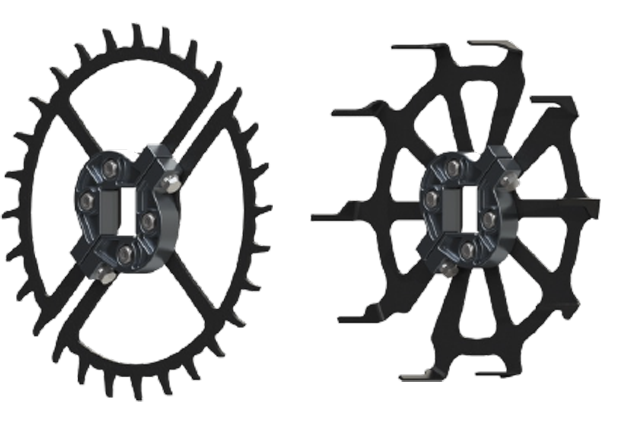
There is a risk of displacing or lifting the seedlings along with the crust when weeding. To avoid this, we have developed special tools: cutting discs and serrated discs. These tools prepare the soil and enable farmers to work aggressively between the rows without damaging the crops.
Rotating tools are particularly effective on very light soils. Weeds are pulled out and their fine roots are cut off, allowing them to dry out efficiently.
Cutting discs to the left and right of the rows protect the crops from soil thrown up by the machine and enable precise separation of untilled and tilled areas, particularly in heavy soils. To completely prevent soil throw, protective tunnels can be used.
Adaptation to all soils
Light soils: Achieve better weeding results than with share hoes — the weeds are pulled out cleanly and dry out on the surface. Share hoes, on the other hand, can encourage regrowth.
Loamy sand (3–5 mm / 0,1-0,2 in crust): The serrated disc is sufficient for breaking the crust and establishing a defined breaking point along the row.
Heavily loamy/clayey soils (thick crusts or silting):
• Cutting discs are necessary in dry conditions
• In wet conditions, use a replacement shaft without cutting discs to prevent clogging. Changing
the replacement shaft takes approx. 5 minutes for one person
• Protective tunnels provide additional protection against soil throwing for very sensitive crops
Application of Pacorel or Rukaby in carrots
Flame weeding before the crop emerges or the application of soil herbicides effectively kills weeds in the pre-emergence stage across the entire area. However, some weeds still manage to emerge, especially when soil herbicides are used.
1.The first weeding takes place at the cotyledon or first leaf stage. Due to the minimal soil disturbance and accurate detection by the camera system, this method is very gentle to the crop.
2. A second or even third weeding takes place, depending on the weed pressure, usually after two weeks and at the latest at the fourth leaf stage, only the ridges and flanks are weeded during ridge formation.
3. From the fourth leaf stage onwards, the carrot leaves become entangled with each other, which means that weeding is still possible outside the rows after removing individual tools. Carrot growth increases between the fourth and sixth leaf stages. After the sixth leaf stage, only the ridges and flanks are weeded during ridge formation.
The Pacorel can be used in addition to existing weeders for ridge floors and slopes. We would be happy to discuss your specific integration requirements. From 2026, a combined hoeing machine that can work on slopes and floors will also be available.
Row guidance systems
Accurate row guidance and precise weeding are particularly important for closely sown crops. Our camera system and automatic row guidance make this possible. The camera detects the rows of plants and controls the sliding frame automatically.
We are currently testing a new camera system which significantly improves the detection of very small onions. We are pleased to offer you this system as a pre-production model.
An alternative to the automatic camera system is to use a joystick in the tractor cab. This requires the tractor driver to electrohydraulically take over the row guidance. A screen has been installed on which the positioning of the tools in relation to the row can be seen. If the tractor is equipped with GPS, the driver can correct the offset from the row in a cost-effective manner.Wenn der Traktor mit GPS fährt kann der Fahrer so kostengünstig den Versatz zur Reihe korrigieren.