
__ Feldklasse weeding technology for herbs in narrow row spacing
Precise weeding technology that remains free of clogging
Herbs such as dill, parsley, chives and coriander tend to grow slowly after sowing. The Rukaby really shines here: thanks to its patented design, it doesn‘t push soil to the side, so you can weed very close to the row and get it done early.
The hydraulically driven tools clean themselves effectively through their rotation. This is particularly advantageous when there is heavy weed growth or after cutting herbs, as large amounts of organic material remain on the soil surface. As well as providing effective weed control, the Rukaby works the organic material into the soil optimally. There, it can be quickly biodegraded, reducing the risk of disease.
Flexible with Rukaby
The Rukaby can be quickly and easily adapted to different row spacings.
This is made possible by the rotary shares‘ clamping mechanism on the shaft. This enables them to be moved variably along the shaft.
It is also possible to configure a replacement shaft. This is recommended if you frequently switch between different row spacings. Replacement can be carried out quickly and easily by one person in under five minutes.
For late weeding up to a height of 23 cm (14 in), we recommend the Felbyco weeder. The quick-change mechanism on the frame enables you to switch between the Rukaby and Felbyco models swiftly. The sliding frame with camera system can continue to be used.
Smart tools
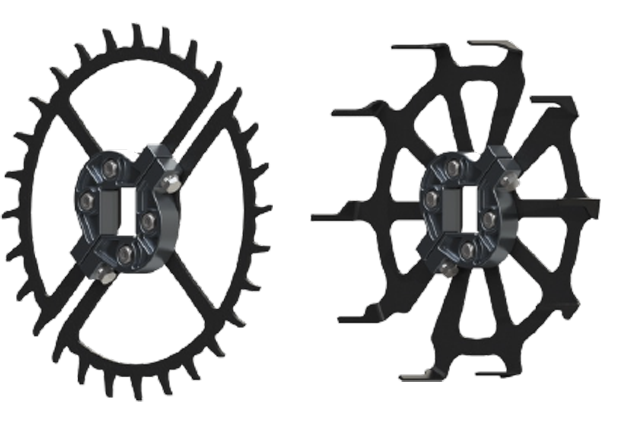
There is a risk of displacing or lifting the seedlings along with the crust when weeding. To avoid this, we have developed special tools: cutting discs and serrated discs. These tools prepare the soil and enable farmers to work aggressively between the rows without damaging the crops.
Rotating tools are particularly effective on very light soils. Weeds are pulled out and their fine roots are cut off, allowing them to dry out efficiently.
Cutting discs to the left and right of the rows protect the crops from soil thrown up by the machine and enable precise separation of untilled and tilled areas, particularly in heavy soils. To completely prevent soil throw, protective tunnels can be used.
Adaptation to all soils
Light soils: Achieve better weeding results than with share hoes — the weeds are pulled out cleanly and dry out on the surface. Share hoes, on the other hand, can encourage regrowth.
Loamy sand (3–5 mm / 0,1-0,2 in crust): The serrated disc is sufficient for breaking the crust and establishing a defined breaking point along the row.
Heavily loamy/clayey soils (thick crusts or silting):
• Cutting discs are necessary in dry conditions
• In wet conditions, use a replacement shaft without cutting discs to prevent clogging. Changing
the replacement shaft takes approx. 5 minutes for one person
• Protective tunnels provide additional protection against soil throwing for very sensitive crops